Partitioning 5 into integers
What is Integer Partitioning Problem?
In Number Theory and Combinatorics, the partition of a positive integer N into a multiset of positive integers, such that the elements sum to N. The number of partitions of the positive integer N is denoted by pₙ.
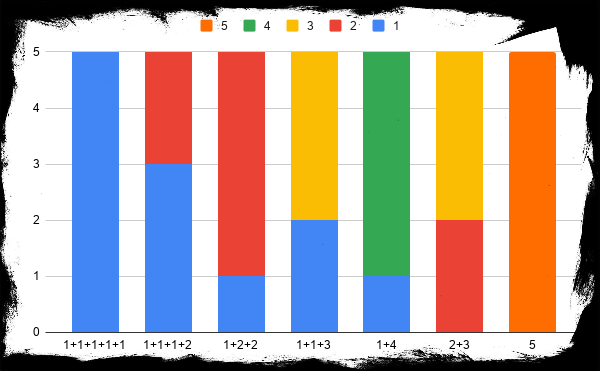
The partitions of 5 are :
5
3 + 2
4 + 1
3 + 1 + 1
2 + 2 + 1
2 + 1 + 1 + 1
1 + 1 + 1 + 1 + 1
Thus p₅ = 7
The number of partitions can be found using Generating Functions GF(x). In fact, the total number of partitions pₙ is equal to the co-efficient of xⁿ in GF(x)
The number of times a certain part is included in a partition formation is reflected in the generating function. Thus for any number of repetitions of any part k the generating function for k becomes

For all such parts, we multiply the individual generating functions, to get

The above one is an infinite product. If we want a particular coefficent pₙ we need only multiply out these factors involving x to a power n or less and are only finitely many of these terms.
To get a finite product, we can calculate the generating function by multiplying polynomials which are finite geometric series. The factor for each part k is expressed as

For example, in the partition of the integer 5, the factor corresponding to 1 is

We know that 5 can be partitioned into two 2s and one 1. And it is quite evident that 5 cannot contain more than two 2s. Thus, the highest power of x² in the factor for 2 need not contain terms greater than (x²)². The factor corresponding to 2 will be 1 + x² + x⁴.
If we revisit the above argument, we can also say that 5 cannot contain three or more than three 2s. This statement is same as discarding the terms which account for three or more than three 2s from the factor which accounts for “any number of repetitions of 2” . Thus the above statemet can be expressed as

Thus, the Generating Function can be expressed as
Find the number of ways 8 can be partitioned into integers
- 8 can contain exactly eight 1s
- 8 can contain exactly four 2s
- 8 can contain maximum two 3s
- 8 can contain exactly two 4s
- 8 can contain maximum one 5
- 8 can contain maximum one 6
- 8 can contain maximum one 7
- 8 can contain exactly one 8
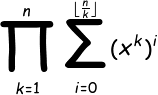
Thus, the Generating Function can be expressed as

The co-efficient of x⁸ in the above expression is the number of ways 8 can be partitioned into integers, that is pₙ = 22
Another application of Integer Partitioning Problem
How many different ways Rs. 200 can be made using denominations of Rs. 1, Rs. 2, Rs. 5, Rs. 10, Rs. 20, Rs. 50, Rs. 100 and Rs. 200?
This problem is the same as the above problems. Here, we have to partition 200 into some specific integers. So, we have to consider the factors of only those integers in the Generating function.
The factor for Rs. 1 is (1+ x + x² + x³ + … + x¹⁹⁹ + x²⁰⁰)
The factor for Rs. 2 is (1+ x² + x⁴ + x⁶ + … + x¹⁹⁸ + x²⁰⁰)
The factor for Rs. 5 is (1 + x⁵ + x¹⁰ + x¹⁵ + … + x¹⁹⁵ + x²⁰⁰)
The factor for Rs. 10 is (1 + x¹⁰ + x²⁰ + x³⁰ + … + x¹⁹⁰ + x²⁰⁰)
The factor for Rs. 20 is (1 + x²⁰ + x⁴⁰ + x⁶⁰ + … + x¹⁸⁰ + x²⁰⁰)
The factor for Rs. 50 is (1 + x⁵⁰ + x¹⁰⁰ + x¹⁵⁰ + x²⁰⁰)
The factor for Rs. 100 is (1 + x¹⁰⁰ + x²⁰⁰)
The factor for Rs. 200 is (1 + x²⁰⁰)
The generating function is the product of all the above factors
(1 + x + x² +…+x²⁰⁰) (1 + x² + x⁴ +…+x²⁰⁰)(1+x⁵+x¹⁰+…+x²⁰⁰)(1+x¹⁰+x²⁰+…+x²⁰⁰)(1+x²⁰+x⁴⁰+…+x²⁰⁰)(1+x⁵⁰+..+x²⁰⁰)(1+x¹⁰⁰+x²⁰⁰)(1+x²⁰⁰)
The number of ways Rs. 200 can be partitioned with the given denominations is 73682, that is p₂₀₀ = 73682
Code for generating Generating Functions in Python
References :
- https://math.berkeley.edu/~mhaiman/math172-spring10/partitions.pdf
- https://www.whitman.edu/mathematics/cgt_online/book/section03.03.html
- Discrete Mathematics and Its Applications — Kenneth Rosen
Originally published on Medium.