with a little help from scikit-learn
Machine Learning models often fails to generalize well on data it has not been trained on. Sometimes, it fails miserably, sometimes it gives somewhat better than miserable performance. To be sure that the model can perform well on unseen data, we use a re-sampling technique, called Cross-Validation.
We often follow a simple approach of splitting the data into 3 parts, namely, Train, Validation and Test sets. But this technique does not generally work well for cases when we don’t have a large datasets. When we have limited data, dividing the dataset into Train and Validation sets may casue some data points with useful information to be excluded from the training procedure, and the model fails to learn the data distrubution properly.
What is K-Fold Cross Validation?
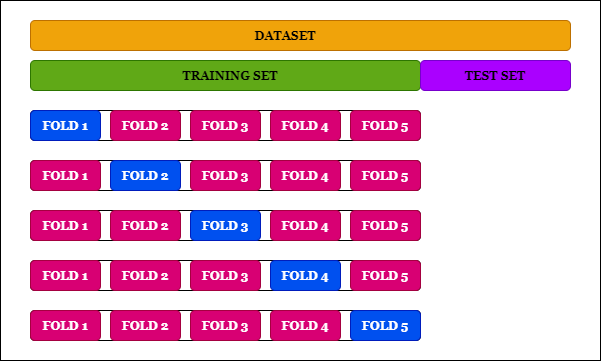
K-Fold CV gives a model with less bias compared to other methods. In K-Fold CV, we have a paprameter ‘k’. This parameter decides how many folds the dataset is going to be divided. Every fold gets chance to appears in the training set (k-1) times, which in turn ensures that every observation in the dataset appears in the dataset, thus enabling the model to learn the underlying data distribution better.
The value of ‘k’ used is generally between 5 or 10. The value of ‘k’ should not be too low or too high. If the value of ‘k’ is too low (say k = 2), we will have a highly biased model. This case is similar to that of splitting the dataset into training and validation sets, hence the bias will be high and variance low. If the value of ‘k’ is large (say k = n (the number of observations)), then this approach is called Leave One Out CV (LOOCV). In this case, bias will be low but the variance will be high and the model will overfit, resulting in the model to fail in generalizing over the test set.
Another approach is to shuffle the dataset just once prior to splitting the dataset into k folds, and then split, such that the ratio of the observations in each class remains the same in each fold. Also the test set does not overlap between consecutive iterations. This approach is called Stratified K-Fold CV. This approach is useful for imbalanced datasets.
Implementation in Keras
1. Importing Required Libraries
Importing Required Libraries
Here, we are assuming that all the images in Train set are in the folder train and the labels of corresponding image files are in a csv file, say training_labels.csv, which has two columns, filename and label.
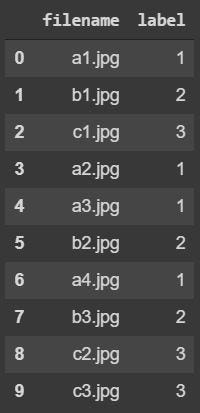
Sample image for training_labels.csv
The column filename either contains only the name of the image file or the whole path to the image file. In case it does not contain the whole file path, otherwise we have to pass the path to the directory in which the images are stored as the directory argument. If one wants to use the method flow_from_directory, then one have to move image files in and out of the folders for each class for any two of the k folds, k number of times, since this method requires the images belonging to one class are present in respective folders under a single master directory. Hence, we can add the path to the image file names, in the csv files.
2. Reading Labels and Creating Splits
Reading the training_labels.csv and creating instances of KFold and StratifiedKFold classes from sklearn
We don’t need to create X, because as mentioned in the documentation page for StratifiedKFold , it is sufficient to provide only the labels Y to generate the splits and hence we can put np.zeros(n_samples) instead of X.
3. Setting Up ImageDataGenerator
idg = ImageDataGenerator(width_shift_range=0.1,
                         height_shift_range=0.1,
                         zoom_range=0.3,
                         fill_mode='nearest',
                         horizontal_flip = True,
                         rescale=1./255)
It can be seen, that the validation_split argument is not given any value as we will be creating the validation set using one of the k splits.
We also need to save the best model in each fold.
4. Helper Function for Model Checkpointing
def get_model_name(k):
    return 'model_'+str(k)+'.h5'
5. Training Across K Folds
This piece of code is shown only for K-Fold CV. For Stratified K-Fold CV, just replace kf with skf.
create_new_model() function return a model for each of the k iterations. New data generators are created in each iteration as the training data and the validation data changes. checkpoint callback is also created with each iteration because to save the best model ineach iteration, we need to give a different file name for the model file in each iteration, otherwise it will be overwritten by the files in the successive iterations. For evaluating the model in each iteration, the weights of the best model is loaded before the model.evaluate() is run. The performance of the models on the validation set is stored at the end.
We can now get the average performance of the model from the list VALIDATION_ACCURACY.
References
- https://en.wikipedia.org/wiki/Cross-validation_(statistics)
- https://scikit-learn.org/stable/modules/cross_validation.html#cross-validation
- https://machinelearningmastery.com/k-fold-cross-validation/
- https://medium.com/@vijayabhaskar96/tutorial-on-keras-imagedatagenerator-with-flow-from-dataframe-8bd5776e45c1
- https://keras.io/preprocessing/image/
Originally published on Medium.