
In this article, we will review the paper which introduced BERT in Language Models. This article is part of a new series of paper review articles, where we will identify the most salient points and contributions of a paper and summarise them in the form of an article.
Please feel free to add any other points that are not mentioned below in the comments.
The major points of the paper mentioned above can be summarized as follows:
Motivation
- The major limitation is the contemporary standard language models were unidirectional, and this limited the choice of architectures that can be used during pre-training.
- For example, in OpenAI GPT, the authors use a left-to-right architecture, where every token can only attend to previous tokens in the self-attention layers of the Transformer (Vaswani et al., 2017).
- Such restrictions are sub-optimal for sentence-level tasks and could be very harmful when applying finetuning-based approaches to token-level tasks such as question answering, where it is crucial to incorporate context from both directions.
What Does BERT Do?
- BERT alleviates the previously mentioned unidirectionality constraint by using a “masked language model” (MLM) pre-training objective, inspired by the Cloze task (Taylor, 1953).
- The “masked language model” randomly masks some of the tokens from the input, and the objective is to predict the original vocabulary ID of the masked word based only on its context.
- Unlike left-to-right language model pre-training, the MLM objective enables the representation to fuse the left and the right context, which allows pre-training of a deep bidirectional Transformer.
- In addition to the masked language model, a “next sentence prediction” task was also used that jointly pretrains text-pair representations.
Architecture
- BERT’s model architecture is a multi-layer bidirectional Transformer encoder based on the original implementation described in Vaswani et al. (2017) and released in the tensor2tensor library.
Data Processing
- To make BERT handle a variety of down-stream tasks, our input representation can unambiguously represent both a single sentence and a pair of sentences (e.g., Question, Answer) in one token sequence
- Throughout this work, a “sentence” can be an arbitrary span of contiguous text, rather than an actual linguistic sentence.
- A “sequence” refers to the input token sequence to BERT, which may be a single sentence or two sentences packed together.
- WordPiece embeddings (Wu et al., 2016) with a 30,000-token vocabulary are used.
- For the pre-training corpus, the authors use BooksCorpus (800M words) (Zhu et al., 2015) and English Wikipedia (2,500M words).
- For Wikipedia, only the text passages are extracted and the rest is ignored. It is critical to use a document-level corpus rather than a shuffled sentence-level corpus such as the Billion Word Benchmark (Chelba et al., 2013) to extract long contiguous sequences.
[SEP] Token
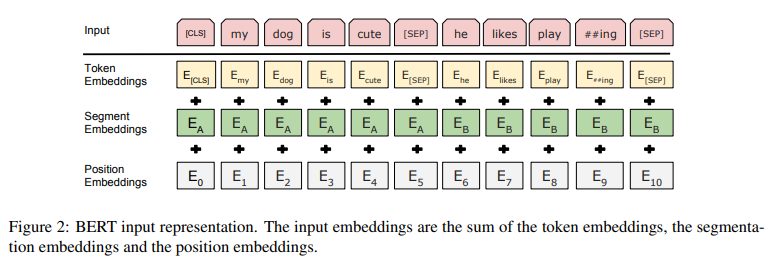
- Sentence pairs are packed together into a single sequence. We differentiate the sentences in two ways. First, we separate them with a special token ([SEP]). Second, we add a learned embedding to every token indicating whether it belongs to sentence A or sentence B.
[CLS] Token
- The first token of every sequence is always a special classification token ([CLS]). The final hidden state corresponding to this token is used as the aggregate sequence representation for classification tasks.
Token Representation
- For a given token, its input representation is constructed by summing the corresponding token, segment, and position embeddings.
Pre-training Objectives
- Unlike Peters et al. (2018a) and Radford et al. (2018), traditional left-to-right or right-to-left language models are not used to pre-train BERT. Instead, we pre-train BERT using two unsupervised tasks, mentioned below.
Task 1: Masked LM (MLM)
- To train a deep bidirectional representation, some percentage of the input tokens are simply masked at random, and then those masked tokens are predicted. This procedure is described as a “masked LM” (MLM), although it is often referred to as a Cloze task in the literature (Taylor, 1953).
- In this case, the final hidden vectors corresponding to the mask tokens are fed into an output softmax over the vocabulary, as in a standard LM.
Task 2: Next Sentence Prediction (NSP)
- To train a model that understands sentence relationships, the authors pre-train for a binarized next-sentence prediction task that can be trivially generated from any monolingual corpus.
- Specifically, when choosing the sentences A and B for each pretraining example, 50% of the time B is the actual next sentence that follows A (labelled as IsNext), and 50% of the time it is a random sentence from the corpus (labelled as NotNext).
- The [CLS] token is used for next-sentence prediction (NSP).
- To fine-tune on GLUE, the first input token C ([CLS]) is used as the aggregate representation and the only new parameters introduced during fine-tuning are classification layer weights W, with K as the number of labels. The standard classification loss is calculated with C and W, i.e., log(softmax(CW^T )).
Originally published on Medium.